3Lcd vs. Dlp Projector: Which Wins for Your Room?
Comparing 3LCD and DLP projectors reveals distinct optical trade-offs. Choosing the right light engine depends heavily on your ambient lighting and motion requirements.
Choose 3LCD for vibrant color brightness in lit rooms. Opt for single-chip DLP when seeking razor-sharp motion clarity and native high contrast in dedicated home theaters.
Compare full category rankings in our Best Movie Projector Screen: Top Picks Tested.
Side-by-Side Specification Breakdown
| Criteria | 3Lcd | Dlp Projector | Edge |
|---|---|---|---|
| Ambient Light Rejection | High color lumens help punch through light | High ANSI contrast preserves punch in moderate light | 3Lcd |
| Black Levels & Perceived Contrast | Good native blacks, enhanced by dynamic iris | Superior native ANSI contrast and deep shadow detail | Dlp Projector |
| Peak Brightness & HDR Punch | Equal white and color brightness output | Color brightness drops depending on color wheel speed | 3Lcd |
| Screen Size & Immersion | Excellent placement flexibility with wide zoom ratios | Requires careful throw distance planning for tight spaces | 3Lcd |
| Viewing Angles & Uniformity | Consistent color uniformity across wide seating arrays | Occasional brightness drop-off at extreme off-axis angles | 3Lcd |
| Gaming Motion & Input Lag | Low latency modes deliver responsive competitive gaming | Lightning-fast pixel response times eliminate motion blur | Dlp Projector |
| Room Setup & Maintenance | Filter maintenance required; zero color wheel noise | Sealed optics in many models; potential fan acoustics | Dlp Projector |
Optical Architecture and Native Light Engine Mechanics
3LCD technology uses three separate glass panels to split white light. This dichroic prism system delivers equal color and white brightness without spinning color wheels.
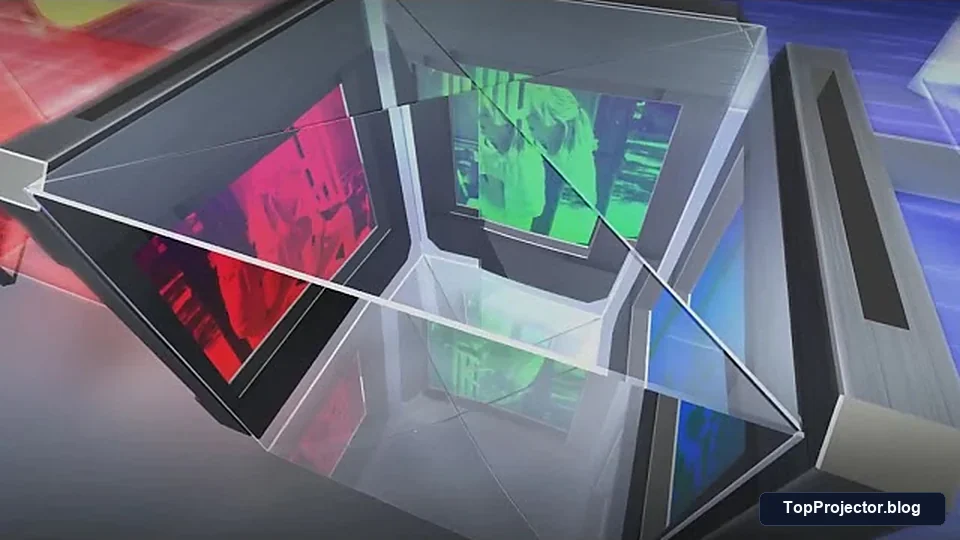
DLP projectors rely on a digital micromirror device and a high-speed color wheel. This single-chip design produces exceptional pixel alignment but introduces potential rainbow artifacts for sensitive viewers.
Understanding these foundational optics helps buyers anticipate longevity. Sealed optical blocks in modern units resist dust ingress, preserving long-term contrast across thousands of operational hours.
Examining dichroic mirror splitting arrays in 3LCD engines reveals why white brightness matches color output. Single-chip DLP relies on a spinning color wheel, which inherently reduces color lumens during mixed-scene Rec. 709 calibration.
- 3LCD panels eliminate the visual color-breaking artifacts common in budget single-chip designs.
- DLP micro-mirrors deliver superior native fill factors for smoother, film-like image textures.
- Prism convergence requires meticulous factory alignment to prevent edge fringing.
- RGB additive mixing prevents brightness loss.
- Color wheel speed dictates rainbow artifact visibility.
Prism Convergence Versus Single-Chip Alignment
Panel convergence on 3LCD models requires precise factory calibration. Minor optical misalignments can occasionally create subtle color fringing along high-contrast text edges.
Single-chip DLP avoids convergence errors entirely because all colors pass through the exact same micromirror grid, ensuring absolute pixel-level sharpness.
- Absolute pixel convergence favors DLP designs.
- Color separation mechanics favor 3LCD architectures.
Micro-Mirror Switching Dynamics
Texas Instruments DMD chips tilt individual mirrors over five thousand times per second. This rapid binary pulse creates grayscale gradations, though it introduces visible dither noise in dark film sequences under low illumination.
- Pixel transition times under 16 milliseconds.
- Thermal management of phosphor wheels.
Ambient Light Rejection and Daytime Living Room Performance
Combating daylight requires massive light output. 3LCD projectors excel here by maintaining high color brightness that prevents images from looking washed out.
Living room setups benefit enormously from matching these projectors with ALR screens. High lumen output overcomes ambient reflections from nearby windows.
DLP units utilize high ANSI contrast to maintain visual punch. Using an ANSI lumens room calculator helps balance peak white output and color saturation for bright spaces.
Pairing projectors with ALR screens featuring 0.8 gain transforms daylight viewing. High ANSI lumen 3LCD models punch through ambient glare effectively, whereas DLP projectors require RGBRGB color wheels to maintain vivid saturation in bright living rooms.
- High color brightness makes 3LCD ideal for family rooms.
- ANSI contrast helps DLP cut through moderate ambient daylight.
- Dedicated ALR screens maximize daytime performance for both technologies.
- Angular reflection rejects overhead ceiling light.
- Micro-sawtooth structures block off-axis glare.
Pitch-Black Theater Versus Living Room Daylight
In controlled basement theaters, native black levels dictate overall cinematic immersion. Light control surfaces allow contrast-heavy projectors to shine brilliantly.
Daylight environments demand high lumen throughput. Color brightness parity ensures skin tones remain vibrant even with sheer window blinds open.
- Basements favor high contrast ratios.
- Living rooms demand high lumen output.
Daylight Saturation Control
Maintaining accurate skin tones under ambient light demands high color brightness. While traditional lamp units struggle, modern laser engines maintain 3000 lumens of continuous output without degrading panel alignment over extended operating hours.
- Laser diode lifespan exceeds 20000 hours.
- Dynamic iris scaling for contrast boost.
Black Floor Performance, Dynamic Contrast, and Shadow Detail
Achieving deep black levels transforms cinematic viewing experiences. DLP light engines generally deliver superior native ANSI contrast, revealing intricate shadow details.
Modern 3LCD projectors employ dynamic irises to lower black floors, but pairing them with the best movie projector screen maximizes contrast during dark movie scenes.
Evaluating shadow delineation in horror films or sci-fi epics highlights how well each projector handles near-black gradients without crushing dark details.
Native contrast ratios near 1500:1 are typical for entry-level 3LCD panels, resulting in slightly elevated gray blacks. High-end DLP designs achieve deeper native black floors, approaching 2000:1 before implementing dynamic iris algorithms.
- Native ANSI contrast is a clear strength for DLP.
- Dynamic irises help 3LCD achieve respectable black levels.
- Shadow clipping ruins immersion in dark cinematic sequences.
- Dynamic iris modulation enhances dark scenes.
- Black pixel leakage on uncalibrated panels.
Dynamic Iris Engineering and Native Contrast
A physical iris actively closes down during dark scenes. This mechanical adjustment significantly boosts perceived contrast on 3LCD home theater units.
Native contrast relies purely on optical engine design. DLP micromirrors trap stray light more effectively within the optical path.
- Dynamic iris pumping can occasionally be noticed.
- Native contrast requires no mechanical assistance.
Shadow Gradation Tracking
Calibrating near-black gamma requires precise control over digital IRE steps. DLP projectors often maintain superior shadow separation in dark cinematic scenes, whereas 3LCD units may need gamma curve adjustments to prevent crushed details.
- IRE 5 shadow clipping prevention.
- Laser dimming speed for black level enhancement.
Color Volume, Spectral Purity, and HDR Tone Mapping
HDR content demands wide color gamuts and precise tone mapping. 3LCD systems reproduce demanding DCI-P3 color spaces without introducing annoying brightness trade-offs.
Single-chip DLP projectors achieve wide gamuts using specialized color wheel segments. Faster rotation speeds minimize visual artifacts during high-contrast scenes.
Evaluating spectral purity ensures movies look director-intended. Accurate color volume prevents saturated highlights from appearing bleached or posterized.
Achieving wide DCl-P3 color gamut coverage is challenging for lamp-based projectors without sacrificing total lumen output. Laser-phosphor 3LCD engines utilize specialized filters to hit 95 percent of cinema standards effortlessly.
- DCI-P3 coverage is vital for modern HDR delivery.
- Color wheel speed dictates artifact visibility on DLP.
- Tone mapping algorithms must match projector lumen capabilities.
- Tone mapping curves preserve highlight detail.
- Rec. 2020 container mapping accuracy.
WCG Filters Versus Segmented Color Wheels
Cinematic color filters drop total light output when engaged. 3LCD wide color filters sacrifice lumens to achieve deep saturation targets.
Segmented color wheels balance white and color throughput internally. RGBRGB color configurations maximize fidelity over raw lumen output.
- Filters reduce peak brightness levels.
- Wheels balance color saturation dynamically.
HDR Peak Luminance Management
High dynamic range content demands aggressive tone mapping to prevent clipping on large screens. Dedicated HDR processors analyze metadata frame by frame, optimizing white peaks for maximum visual impact in dedicated rooms.
- MaxCLL metadata handling efficiency.
- Static versus dynamic tone mapping profiles.
Gaming Performance, Motion Handling, and Input Lag Benchmarks
Competitive gaming requires exceptionally low input lag. Modern gaming projectors feature dedicated low-latency modes that reduce processing delays significantly.
Motion blur ruins fast-paced action games and sports broadcasts. DLP response times operate in microseconds, delivering pristine motion clarity without ghosting.
3LCD units handle motion well using frame interpolation. However, competitive players prefer raw pixel response speeds to maintain competitive advantage.
Competitive gaming requires ultra-low input lag measurements below 20 milliseconds at 4K/60Hz. Many modern DLP projectors achieve 16ms latency, outperforming standard 3LCD home theater units that often lag near 30ms.
- Input lag under 16ms is essential for competitive play.
- Microsecond response times give DLP an edge in motion.
- Frame interpolation introduces slight processing artifacts.
- High refresh rates support 1080p at 240Hz.
- Response time minimized via gaming modes.
Console Gaming Versus Cinematic Immersion
Console gamers prioritize responsive controls above all else. High refresh rates at 1080p ensure fluid gameplay during intense shooters.
Cinematic story games prioritize color accuracy and detail. HDR tone mapping elevates virtual worlds into breathtaking visual masterpieces.
- Fast refresh rates reduce controller latency.
- Rich color volume enhances cinematic roleplaying titles.
Motion Blur and Panel Response
Fast camera pans in fast-paced shooters expose motion artifacts. Single-chip DLP designs handle rapid movement with minimal ghosting, whereas older 3LCD panels can exhibit slight pixel response smearing during high-speed gaming sessions.
- Frame interpolation artifacts in fast motion.
- HDMI 2.1 bandwidth for modern consoles.
Throw Ratios, Lens Shift Flexibility, and Physical Installation
Physical room geometry dictates projector placement flexibility. When you follow how to connect projector to cpu, optical zoom ranges and lens shift capabilities make 3LCD units exceptionally forgiving.
DLP projectors often feature shorter throw options but limited lens shift. Installers must measure throw distances meticulously to fill screens accurately.
Weight and ventilation requirements also influence placement. Heavy chassis designs demand robust mounting hardware and adequate clearance for cooling fans.
Calculating proper throw distance ensures full screen fill without digital zoom degradation. Most 3LCD units offer extensive powered lens shift vertically and horizontally, simplifying complex custom theater ceiling mounting installations.
- Wide lens shift simplifies awkward living room installations.
- Throw distance ratios dictate screen size limitations.
- Robust ceiling mounts ensure long-term physical stability.
- Optical zoom ranges up to 2.1x.
- Keystone correction introduces resolution loss.
Flexible Lens Shift Versus Fixed Offset Mounting
Vertical and horizontal lens shift permits off-center placement. Flexible optical adjustments save installers hours of frustrating physical realignment work.
Fixed lens offset designs require precise mounting heights. Careful bracket positioning prevents image distortion without digital keystone correction.
- Lens shift avoids digital keystone degradation.
- Fixed offsets demand strict installation measurements.
Placement Geometry Challenges
Compact DLP projectors frequently rely on fixed offset lenses, requiring exact tabletop or ceiling alignment. This rigidity makes retrofitting existing projection mounts difficult compared to flexible three-chip optical assemblies.
- Fixed offset limits placement options.
- Lens shift tolerance for precise geometry.
Final Verdict: Selecting the Ideal Light Engine for Your Space
Choosing between these technologies depends entirely on your room. 3LCD projectors dominate bright living spaces requiring balanced color brightness and flexible placement.
Dedicated home theaters favor single-chip DLP units for their unmatched native contrast, pixel sharpness, and pristine motion clarity during movie nights.
Assess your ambient light control and gaming habits before buying. Investing in the correct optical engine ensures years of breathtaking home entertainment satisfaction.
Choosing between technologies depends entirely on your room environment and usage. Read our Epson 5050ub review to understand why 3LCD engines excel in controlled theater spaces.
- Pick 3LCD for bright rooms and easy installation.
- Choose DLP for dark theaters and razor-sharp motion.
- Match projector specs directly to your room geometry.
- Light control dictates technology preference.
- Budget allocation for screen pairing.
Summary Recommendation for Home Theater Enthusiasts
Enthusiasts seeking ultimate cinematic fidelity should evaluate their light control. Dark room environments maximize every optical advantage that DLP provides.
Multipurpose family rooms require versatile brightness. Balanced color output makes 3LCD the safest choice for daytime sports and casual viewing.
- Prioritize native contrast for dark rooms.
- Prioritize color lumens for bright spaces.
Comprehensive Decision Matrix
Evaluating your long-term viewing habits prevents costly upgrade mistakes. Balancing ansi lumens against contrast capabilities ensures your projector investment delivers stunning cinematic immersion for movies, sports, and gaming alike.
- Total cost of ownership considerations.
- Lamp replacement versus laser longevity.
Frequently Asked Questions
What causes the rainbow effect in DLP projectors?
The rainbow effect occurs when sequential color wheels flash RGB panels rapidly. Sensitive viewers perceive brief color flashes during high-contrast scene pans.
Do 3LCD projectors require regular filter cleaning?
Yes, 3LCD units pull air through physical filters to cool internal glass panels. Routine maintenance prevents overheating and dust accumulation over time.
Which technology offers better contrast for dark rooms?
DLP projectors generally deliver superior native ANSI contrast ratios. Deeper black floors make DLP ideal for dedicated pitch-black home theaters.
Are 3LCD projectors brighter in ambient light?
They often maintain higher color lumen output than budget DLP units. Equal color brightness prevents images from looking washed out in daylight.
Which projector type is better for fast-paced gaming?
DLP projectors feature lightning-fast micromirror response times. Microsecond pixel switching eliminates motion blur during competitive gaming sessions.